指南与共识|全胃切除病人全程营养管理中国专家共识(2026版)
问题2.拟行TG病人是否推荐术前进行多模式预康复
胃癌病人因肿瘤消耗、进食障碍等因素,常存在营养不良、肌肉减少和心肺功能下降,是预康复的重点人群。一项随机对照试验(RCT)研究结果显示,围手术期系统的肺部训练可降低术后肺部并发症发生率(45.0% vs. 26.2%),并缩短术后住院时间[15]。呼吸训练作为预康复的一部分,在加速康复外科(enhanced recovery after surgery,ERAS)方案中显示出潜在益处[16-17]。Chandoo等[18]的研究结果提示,步速慢的老年病人术后并发症发生风险更高,而Steffens等[19]指出术前体能优化可提高功能状态。此外,针对肌肉减少症和术后肌肉流失的干预可能改善预后[20]。国内胃癌病人从确诊到手术的平均等待时间较短(1~2周),难以完成4~6周标准预康复,需探索短期强化方案(如1周高蛋白饮食+高强度间歇训练等)。 推荐意见3:建议TG病人入院后个体化采用以呼吸训练、运动训练、营养治疗和心理干预为核心的多模式预康复训练以改善术后结局。(证据等级:A;推荐强度: 强推荐)
问题3.TG术中如何选择消化道重建方式
消化道重建是TG的关键步骤,其方式选择直接影响病人的术后生活质量、营养治疗效果以及并发症发生率。目前,食管空肠吻合(Roux-en-Y吻合)是临床最常用的重建方式[21-23]。Rea等[24]建议Roux袢长度>40 cm以减少胆汁反流。Roux-en-Y吻合也常联合储袋重建,在空肠段形成储袋样结构模拟胃的储存功能,可能有助于改善摄食量和体重恢复[25-26]。根据消化道重建的吻合方式不同,可分为圆形吻合器吻合、直线切割闭合器吻合以及完全手工吻合。直线切割闭合器吻合方式主要包括食管空肠顺蠕动侧侧吻合(Overlap)、功能性端端吻合(functional end-to-end anastomosis,FEEA)和π型吻合。圆形吻合器吻合方式主要包括荷包缝合法、OrVilTM吻合法和反穿刺法[27-30]。在具备术中内镜检查条件的医学中心,完成消化道重建后建议采用内镜评估吻合口情况,为术后早期经口喂养提供依据。 推荐意见4:推荐TG术中选择以Roux-en-Y吻合为核心的消化道重建方式,并采用术中胃镜评估吻合口质量。(证据等级:B;推荐强度: 强推荐)
问题4.TG术中是否行空肠营养造口
早期经口喂养(early oral feeding,EOF)背景下,TG病人是否需要进行空肠营养造口存在较大争议。Li等[31]研究中对比98例行空肠营养造口与149例未行空肠营养造口病人的术后营养状况,结果显示,行空肠营养造口病人术后1个月血清白蛋白、血清前白蛋白和血红蛋白浓度更高。可见,术后通过空肠营养造口进行早期肠内营养(enteral nutrition,EN)治疗可改善营养状况,且并未增加术后并发症发生率。Jaquet等[32]的一项队列研究结果显示,TG术中行空肠营养造口有助于降低术后感染及Ⅲ级并发症发生率,但对术后近、远期生存率无影响。Deepjyoti等[33]的研究结果显示,与鼻空肠营养管饲组比较,空肠营养造口组病人住院时间和并发症发生率增加,而营养治疗结果差异无统计学意义。对于存在营养风险病人,肠外营养(parenteral nutrition,PN)或鼻空肠管可作为短期替代方案,以避免造口相关并发症[34-35]。是否行空肠营养造口应充分考虑病人的具体情况,如年龄、身体状况、手术风险及营养治疗时间等因素。对于身体状况较差、手术风险较高的病人,可以谨慎评估其耐受性和风险后,再决定是否行空肠营养造口。 推荐意见5:不推荐TG病人术中常规行空肠营养造口。对于营养风险高的病人,在评估其耐受性和风险后,可行空肠营养造口。(证据等级:B;推荐强度: 弱推荐)
问题5.TG病人术后给予EN的时机和途径如何选择
多项研究结果表明,TG术后EOF可显著缩短住院时间,且不增加并发症风险[36-39]。EOF有助于保护肠道黏膜屏障功能,减少肠道菌群失调,促进营养吸收[40-41]。TG术后普遍存在营养不良(如贫血、低蛋白血症等),延迟营养干预将加剧肌肉量减少和代谢紊乱,也将导致肠道功能恢复缓慢,增加住院时间及医疗成本[42-43]。一项回顾性研究对比EOF和较晚经口喂养(late oral feeding,LOF)的围手术期结局,EOF组在首次排气排便时间和住院时间方面均显著优于LOF组,而且两组并发症发生率差异并无统计学意义[44]。Wang等[45]的单中心RCT研究也得出了相似的结论。一项Meta分析结果表明,EOF可缩短TG病人术后住院时间、首次排气时间以及降低住院费用,并与术后吻合口漏发生无明显相关性[46]。 一项前瞻性多中心RCT研究结果表明,留置鼻空肠营养管与未留置的病人比较,在术后吻合口漏和其他并发症风险上差异均无统计学意义,不支持TG常规留置鼻空肠营养管[47]。Akbaba等[48]的前瞻性队列研究和Carrère等[49]的随机对照试验(RCT)结果均证明,TG常规留置鼻胃管进行胃肠减压并未使病人获益。一项回顾性研究结果表明,TG不留置鼻空肠营养管是安全的[50]。Wang等[51]的一项前瞻性研究结果也证明了TG不置入鼻空肠营养管的安全性,但也并未加快术后恢复过程。Yoshikawa等[52]的一项回顾性研究结果表明,在术后1 d即开始经口喂养的ERAS背景下,术中不留置鼻空肠营养管并不增加术后并发症风险。一项Meta分析结果同样表明,除严重呕吐或腹胀的病人外,TG无需常规留置鼻空肠管[53]。 推荐意见6:推荐TG术后个体化进行EOF,不推荐常规留置鼻胃管和鼻空肠营养管。(证据等级:A;推荐强度: 强推荐) 推荐意见7:对存在吻合口并发症高危因素或预期EOF不耐受者,可在TG术中留置鼻空肠营养管,以便术后实施早期管路EN。(证据等级:A;推荐强度: 强推荐)
问题6.TG病人是否应用含有免疫营养素配方的EN制剂
一项TG病人营养治疗方案的Meta分析结果显示,应用肠内免疫营养可提高其细胞免疫功能,调节炎性反应,减少术后并发症[54]。我国的一项RCT研究结果证实,围手术期给予肠内免疫营养可提高胃癌根治术病人的术后免疫和肠黏膜屏障功能,降低术后并发症发生率,并加快病人恢复[55]。Peker等[56]从免疫学角度研究免疫营养素影响,发现术前口服免疫营养素会增加胃癌组织浸润性淋巴细胞和血管生成,从而增强免疫系统抗肿瘤活性。我国的一项RCT研究结果同样证实,应用富含精氨酸、谷氨酰胺和核苷酸配方的EN制剂有助于提高T细胞水平和免疫球蛋白计数,但对炎症介质影响较小[57]。免疫营养素除了对胃癌术后短期并发症产生影响外,还可改善胃癌病人的预后[58-59]。 推荐意见8:推荐TG病人围手术期使用含有免疫营养配方的EN制剂。(证据等级:A;推荐强度: 强推荐)
问题7.TG术后何时开始给予补充性肠外营养
Heidegger等[60]的RCT研究结果显示, 与单纯给予EN的病人比较,给予EN联合补充性肠外营养(supplemental parenteral nutrition,SPN)治疗的病人院内感染发生率显著降低,临床预后明显改善。腹部大手术后EN联合SPN可以有效保证充足的营养供给并改善病人的营养状况[61-62]。早期给予PN对不符合早期EN条件的危重病人能够实现足够热量和蛋白质的供应,并可降低营养不良高危病人的病死率[63]。2022年,一项多中心RCT研究纳入我国11家三甲医院收治的230例行腹部手术的病人,比较早期SPN(术后第3天)与晚期SPN(术后第8天)对存在高营养风险且EN耐受不良的腹部大手术病人院内感染发生率的影响,结果表明,EN摄入不足目标量的60%时启动SPN(术后3~5 d)可显著降低肝功能异常风险和代谢并发症发生率[64]。该研究建议,当单独使用EN的能量供给不足时,需及时给予SPN,使病人得到充足能量供应。早期SPN与EN相结合可以显著改善术后早期的能量不足。早期SPN组病人术后胃肠功能障碍发生率低于晚期SPN组。一项RCT研究结果显示,老年胃癌病人从术后第2天开始给予SPN,有助于促进胃肠功能恢复,降低腹泻等胃肠不良反应发生率,改善肝肾功能,降低感染发生率、缩短住院时间[65]。对于存在营养风险(NRS 2002评分≥3分)或术后72 h内无法通过肠内途径满足目标能量需求60%的病人,建议在术后24~48 h内启动SPN以维持正氮平衡[66]。微创手术技术的应用可缩短术后肠功能恢复时间,这为EN联合SPN向完全EN的早期过渡提供了有利条件[67]。 推荐意见9:EN联合SPN是TG病人术后营养治疗主要模式;若预计48~72 h EN无法满足机体目标能量及蛋白质需要量60%时,建议尽早给予SPN。(证据等级:A;推荐强度: 强推荐)
问题8.TG术后全肠外营养适应证
全肠外营养(total parenteral nutrition,TPN)主要用于TG术后持续性肠功能障碍等EN禁忌证及不能耐受EN的病人[31]。对于术前存在营养不良(如BMI<18.5或血清白蛋白<30 g/L)或术后预期营养吸收障碍(如倾倒综合征、维生素B12缺乏)的病人,需在术后早期评估营养风险,TPN可通过提供足够热量与蛋白质降低分解代谢相关的负氮平衡及并发症发生率[68-69]。须注意,TPN并非TG术后的常规营养支持方案。多项RCT研究结果表明,与单纯TPN相比,早期EN或EN联合SPN可显著降低术后感染发生率,促进肠道功能恢复并改善长期营养指标[70-71]。 推荐意见10:TG病人不能耐受EN或存在EN禁忌证时,推荐给予TPN。(证据等级:A;推荐强度: 强推荐)
问题9.是否建议TG病人补充谷氨酰胺
TG术后病人机体处于强烈的应激和高代谢状态,谷氨酰胺水平急剧下降[72]。作为条件必需氨基酸,谷氨酰胺在维持肠道屏障功能、调节免疫应答及促进蛋白质合成中具有重要作用。多项RCT研究结果证实,术后联合应用谷氨酰胺可显著改善营养状态,与常规EN组相比,谷氨酰胺组病人术后血清总蛋白、白蛋白、前白蛋白及转铁蛋白水平显著提升(P<0.05)[57,73]。Meta分析结果显示,围手术期应用谷氨酰胺可缩短住院时间[74]。Wu等[75]研究结果表明,补充谷氨酰胺可显著改善术后低白蛋白血症。一项回顾性研究结果显示,术后及时补充谷氨酰胺可改善肌肉减少症及肌肉萎缩,促进病人体力恢复,从而提升生活质量[76]。研究结果表明,机器人辅助TG病人应用谷氨酰胺联合支链氨基酸可协同抑制肌肉蛋白分解,维持氮平衡[77]。 推荐意见11:推荐TG病人术后合理补充谷氨酰胺,但对于重症或合并严重肝肾功能障碍的病人,不推荐使用谷氨酰胺。(证据等级:B;推荐强度: 强推荐)
问题10.TG病人SPN配方中是否建议补充鱼油脂肪乳
一项纳入111例胃癌病人的回顾性研究结果显示,术后补充鱼油组病人并发症发生率低于对照组,提示鱼油对术后早期康复具有显著促进作用[78]。Yang等[79]的前瞻性队列研究结果进一步证实,鱼油组病人术后第5天总蛋白、白蛋白及前白蛋白水平恢复至接近术前基线,且总体并发症发生率显著低于对照组。Wei等[80]揭示了鱼油通过抑制白细胞介素6(IL-6)、肿瘤坏死因子α(tumor necrosis factor α,TNF-α)等促炎因子分泌,增加白细胞计数,降低感染性并发症发生率。一项Meta分析结果表明,鱼油脂肪乳剂通过抗炎、免疫调节和代谢支持作用,可显著降低TG病人的术后感染风险、缩短住院时间,并可能改善肝功能[81]。 推荐意见12:TG术后推荐在SPN配方中添加鱼油脂肪乳剂。(证据等级:B;推荐强度: 强推荐)
问题11.TG病人术后如何选择EN制剂
TG病人常用整蛋白型和短肽型EN制剂。短肽型EN制剂中蛋白质已被水解成小肽链,更容易消化吸收,可用于吸收不良或对标准配方有胃肠道不耐受的病人,而且短肽型通常蛋白质含量更高。整蛋白型EN制剂通常含有完整的营养成分,包括碳水化合物、脂肪和以大豆蛋白分离物或酪氨酸盐形式存在的蛋白质,需要消化才能吸收[82]。2020年,一项随机对照研究结果指出,与整蛋白型比较,应用短肽型EN可使TG术后病人的前白蛋白水平更高,还可降低术后腹胀发生率,缩短术后排气时间,但应用整蛋白型病人的腹泻发生率相对较低,且术后住院时间更短[83]。另有两项研究结果表明,相较于整蛋白型制剂,应用短肽型制剂病人术后早期腹泻、腹胀、呕吐等EN不耐受的发生率更低[84-85]。有研究比较TG术后应用此两种EN制剂病人的静脉血胃泌素及胃动素水平,结果显示,应用短肽型制剂者胃泌素及胃动素水平更高。现有研究结果表明,TG术后早期使用短肽型EN制剂有助于降低EN不耐受的发生率。术后长期EN方案可选择整蛋白型营养制剂。 推荐意见13:推荐TG病人术后早期使用短肽型营养制剂,肠道功能稳定后可逐步过渡至整蛋白型。(证据等级:B;推荐强度: 强推荐)
问题12.TG术后发生食管空肠吻合口漏,如何选择治疗方案
食管空肠吻合口漏是TG术后最严重的并发症之一,其发生率为4%~9%[86-87]。外科引流治疗、介入穿刺引流治疗、内镜手术或再次外科手术是可供选择的治疗方法。通过介入引导下放置空肠营养管和穿刺置入引流管,实现EN同时引流漏出液,避免再次手术。 内镜治疗具有创伤小的优势,包括植入覆膜支架、内镜负压治疗和应用组织胶等。Ding等[88]报道了使用外引流方式治疗TG术后食管空肠吻合口漏。Egami等[89]报道了使用自膨胀式支架治疗TG术后吻合口漏的成功经验。Cengiz等[90]同样报道内镜下置入覆膜支架可以作为TG术后食管空肠吻合口漏的有效治疗方式。Schubert等[91]的研究结果显示,在27例食管空肠吻合口漏病人中,有25例经内镜治疗效果良好。手术治疗适用于保守或内镜治疗失败、感染无法控制的病例。 当发生食管空肠吻合口漏时,有研究推荐在X线引导下置入鼻空肠营养管,导管尖端放置在与吻合口距离>40 cm的远端肠管,启动EN开始时的剂量为200~400 mL/d,在第2~6天内增加至1200~1600 mL/d;如果增加摄入量时遇到腹泻或小肠扩张等症状,则加用SPN或TPN[92]。TG术后发生吻合口漏的病人,使用EN或PN的临床结局和总并发症发生率差异无统计学意义。与PN组相比,EN组病人的导管相关并发症较少,且Clavien-Dindo分级≥Ⅱ级并发症的发生风险更低。在诊断为吻合口漏后的第7、10和15天,PN组的白细胞计数和C-反应蛋白水平高于EN组,PN组需要长时间静脉注射抗生素[92]。 推荐意见14:TG术后发生食管空肠吻合口漏病人推荐个体化采用外科引流、内镜下夹闭或引流、内镜下覆膜支架或外科手术治疗。(证据等级:B;推荐强度: 强推荐) 推荐意见15:TG术后发生食管空肠吻合口漏病人推荐通过鼻肠管实施EN,若EN供给不足,推荐联合SPN,甚至TPN。(证据等级:B;推荐强度: 强推荐)
问题13.TG术后发生乳糜漏,如何选择营养治疗方式
营养治疗是术后乳糜漏管理不可或缺的组成部分,有助于减少乳糜流动,最大限度地减少营养损失,改善病人的营养状况,从而提高生存率和生活质量[93]。对于轻度(低流量)乳糜漏[A级(7 d内缓解)]营养策略主要为:低脂饮食、中链甘油三酯(medium chain trilyctrerides,MCTs)饮食、高蛋白、高碳水化合物配方,维持营养状态,并辅助以持续引流监测以及生长抑素来减少淋巴液分泌,缩短病程[94];而对于重度(高流量)乳糜漏[B级(7~14 d内缓解)或C级(>14 d未缓解或需手术治疗)]的营养策略则为:TPN联合生长抑素,逐渐过渡至MCTs饮食[95-97]。保守治疗无效的持续高流量漏则需要进行淋巴管栓塞或手术修复[96]。 推荐意见16:对于TG术后发生高流量乳糜漏病人,推荐禁食联合TPN和生长抑素治疗,低流量乳糜漏可尝试低脂饮食、MCTs、高蛋白和高碳水化合物饮食,或禁食联合TPN治疗。(证据等级:C;推荐强度: 弱推荐)
问题14.TG病人出院后是否建议补充微量元素和维生素
TG术后病人普遍存在维生素B12、维生素D、钙、铁、硅等重要微量元素的缺乏风险[98-99]。其中维生素B12的缺乏尤为突出,这是由于胃切除后内因子的分泌终止,导致维生素B12无法在回肠有效吸收,增加了发生巨幼细胞性贫血的风险。维生素B12吸收障碍,其发生率高达48.8%,临床表现为贫血、疲劳、四肢麻木等症状[100]。因此,临床上建议术后病人应定期注射或高剂量口服补充维生素B12,以防止发生严重贫血[101-103]。此外,维生素D缺乏在TG术后病人中也较常见,这种缺乏可能导致病人骨矿物质密度显著降低而引发骨质疏松,通过联合补充维生素D、钙以及双膦酸盐,可以更有效地改善病人的骨密度,降低骨质疏松风险。然而,目前尚无高质量研究就剂量和补充方案提出具体的强烈建议[104]。 铁缺乏和贫血也是术后长期随访中须关注的重要问题。TG术后病人因胃酸缺乏,影响铁的溶解和吸收,导致贫血发生率明显升高。研究结果显示,术后1年内贫血的发生率与5年内贫血的累积发生率均出现了显著上升,特别是在女性、低BMI及糖尿病病人中风险更高。TG术后应常规监测血红蛋白和铁代谢指标,及时给予口服铁剂补充,并建议与维生素C同时服用以提高铁吸收效率。有研究结果指出,TG术后血浆硅水平明显降低可能进一步加剧骨质流失,提示术后应关注硅的补充问题[98]。此外,术后蛋白质代谢紊乱明显,可导致病人肌肉量显著减少,出现术后肌少症的现象。早期给予富含精氨酸的EN能有效改善术后负氮平衡,提高蛋白质合成率[105]。推荐术后早期补充足量优质蛋白质,防止病人营养状况进一步恶化[106]。 推荐意见17:推荐TG术后病人及早补充维生素B12,并根据个体情况适量补充维生素D、钙、铁、硅及其他微量元素,术后3、6、12个月时监测营养状况和骨密度。(证据等级:B;推荐强度: 强推荐)
问题15.TG病人出院后口服营养补充的时间
有研究结果指出,术后3个月内是体重快速流失的关键时期,之后趋于稳定,在该阶段进行口服营养补充(oral nutritional supplement,ONS)可显著减少体重丢失,并影响远期预后[107-108]。一项回顾性研究结果表明,TG术后应用ONS时间>3个月可以显著改善老年病人骨骼肌萎缩和营养不良情况[109]。Hatao等[110]的研究结果表明,出院后进行ONS可以显著改善TG术后体重减轻。另有文献报道,术后6个月及更长时间微量元素的缺乏仍然普遍存在,可通过ONS进行长期补充[111-114]。有研究结果发现胃癌手术后1年是预测长期生存的关键时间点,病人此阶段经历显著的营养代谢变化和肌肉流失,故在术后1年内,有必要进行积极的营养干预[115]。多模式干预可能较单一ONS更有效预防肌肉萎缩。 推荐意见18:TG术后推荐进行3~6个月ONS,并可根据病人实际营养状态将ONS延长至≥12个月。(证据等级:C;推荐强度: 强推荐)  参考文献 (在框内滑动手指即可浏览) [1] Kang MK, Lee HJ. Impact of malnutrition and nutritional support after gastrectomy in patients with gastric cancer[J]. Ann Gastroenterol Surg,2024, 8(4):534-552. DOI: 10.1002/ags3.12788. [2] Akad F, Filip B, Preda C, Zugun-Eloae F, et al. Assessing nutritional status in gastric cancer patients after total versus subtotal gastrectomy: Cross-sectional study[J]. Nutrients,2024, 16(10):1485. DOI: 10.3390/nu16101485. [3] Durán-Poveda M, Suárez-de-la-Rica A, Cancer Minchot E, et al. Knowledge and practices of digestive surgeons concerning specialized nutritional support in cancer patients: A survey study[J]. Nutrients,2022, 14(22):4764. DOI: 10.3390/nu14224764. [4] Yun L, Zhiwei J, Junsheng P, et al. Comparison of functional outcomes between functional jejunal interposition and conventional Roux-en-Y esophagojejunostomy after total gastrectomy for gastric cancer[J]. Dig Surg,2020, 37(3):240-248. DOI: 10.1159/000501677. [5] Su W, Yang Y, Wang Q, et al. Efficacy of the nutritional support team model in the management of patients undergoing total gastrectomy combined with Roux-en-Y anastomosis[J]. Pak J Med Sci,2025, 41(1):141-146. DOI: 10.12669/pjms.41.1.11112. [6] Wang HM, Wang TJ, Huang CS, et al. Nutritional status and related factors in patients with gastric cancer after gastrectomy: A cross-sectional study[J]. Nutrients,2022, 14(13):2634. DOI: 10.3390/nu14132634. [7] Kondrup J, Rasmussen HH, Hamberg O, et al. Nutritional risk screening (NRS 2002): A new method based on an analysis of controlled clinical trials[J]. Clin Nutr, 2003, 22(4): 321-336. DOI: 10.1016/s0261-5614(02)00214-5. [8] Huang DD, Cai HY, Chen XY, et al. Value of sarcopenia defined by the new EWGSOP2 consensus for the prediction of postoperative complications and long-term survival after radical gastrectomy for gastric cancer: A comparison with four common nutritional screening tools[J]. J Cancer, 2020, 11(19): 5852-5860. DOI: 10.7150/jca.49815. [9] Jensen GL, Cederholm T, Correia M, et al. GLIM criteria for the diagnosis of malnutrition: A consensus report from the global clinical nutrition community[J]. J Parenter Enteral Nutr, 2019, 43(1): 32-40. DOI: 10.1002/jpen.1440. [10] Xu LB, Mei TT, Cai YQ, et al. Correlation between components of malnutrition diagnosed by global leadership initiative on malnutrition criteria and the clinical outcomes in gastric cancer patients: A propensity score matching analysis[J]. Front Oncol, 2022, 12: 851091. DOI: 10.3389/fonc.2022.851091. [11] Sun S, Huang W, Wang Z, et al. Association of malnutrition diagnosed using global leadership initiative on malnutrition criteria with severe postoperative complications after gastrectomy in patients with gastric cancer[J]. J Laparoendosc Adv Surg Tech A, 2023, 33(12): 1193-1200. DOI: 10.1089/lap.2023.0310. [12] Huang DD, Yu DY, Song HN, et al. The relationship between the GLIM-defined malnutrition, body composition and functional parameters, and clinical outcomes in elderly patients undergoing radical gastrectomy for gastric cancer[J]. Eur J Surg Oncol, 2021, 47(9): 2323-2331. DOI: 10.1016/j.ejso.2021.02.032. [13] Zhou J, Yang S, Liu T, et al. Diagnostic performance of GLIM and PG-SGA for malnutrition assessment in adult cancer patients: A systematic review and Meta-analysis[J]. BMC Cancer, 2025, 25: 765. DOI: 10.1186/s12885-025-13809-6. [14] Jager-Wittenaar H, Ottery FD. Assessing nutritional status in cancer: role of the Patient-Generated Subjective Global Assessment[J]. Curr Opin Clin Nutr Metab Care, 2017, 20(5): 322-329. DOI: 10.1097/mco.0000000000000389. [15] Zheng X, Gao Z, Li Y, et al. Impact and effect of preoperative short-term preoperative pulmonary-related training on patients with gastric cancer: A randomized controlled single center trial[J]. J Gastrointest Surg, 2024, 28(12): 1819-1827. DOI: 10.1016/j.gassur.2024.08.020. [16] Swaminathan N, Kundra P, Ravi R, et al. ERAS protocol with respiratory prehabilitation versus conventional perioperative protocol in elective gastrectomy- A randomized controlled trial[J]. Int J Surg, 2020, 81: 149-157. DOI: 10.1016/j.ijsu.2020.07.027. [17] Tanaka R, Lee SW, Kawai M, et al. Protocol for enhanced recovery after surgery improves short-term outcomes for patients with gastric cancer: A randomized clinical trial[J]. Gastric Cancer, 2017, 20(5): 861-871. DOI: 10.1007/s10120-016-0686-1. [18] Chandoo A, Chi CH, Ji W, et al. Gait speed predicts post-operative medical complications in elderly gastric cancer patients undergoing gastrectomy[J]. ANZ J Surg, 2018, 88(7-8): 723-726. DOI: 10.1111/ans.14325. [19] Steffens D, Young J, Riedel B, et al. PRehabIlitatiOn with pReoperatIve exercise and educaTion for patients undergoing major abdominal cancer surgery: Protocol for a multicentre randomised controlled TRIAL (PRIORITY TRIAL)[J]. BMC Cancer, 2022, 22(1): 443. DOI: 10.1186/s12885-022-09492-6. [20] Kuwada K, Kikuchi S, Kuroda S, et al. Survival impact of postoperative skeletal muscle loss in gastric cancer patients who underwent gastrectomy[J]. Anticancer Res, 2023, 43(1): 223-230. DOI: 10.21873/anticanres.16153. [21] Wang J, Wang Q, Dong J, et al. Total laparoscopic uncut Roux-en-Y for radical distal gastrectomy: An interim analysis of a randomized, controlled, clinical trial[J]. Ann Surg Oncol, 2021, 28(1): 90-96. DOI: 10.1245/s10434-020-08710-4. [22] Yin Q, Zhang G, Qie P, et al. Total laparoscopic total gastrectomy and distal esophagectomy combined with reconstruction by transhiatal esophagojejunal Roux-en-Y mediastinal anastomosis for Siewert Ⅱ AEG[J]. J Cardiothorac Surg, 2023, 18(1): 339. DOI: 10.1186/s13019-023-02453-5. [23] Naum C, Bîrlă R, Marica DC, et al. In search of the optimal reconstruction method after total gastrectomy. is Roux-en-Y the best? A review of the randomized clinical trials[J]. Chirurgia (Bucur), 2020, 115(1): 12-22. DOI: 10.21614/chirurgia.115.1.12. [24] Rea T, Bartolacci M, Leombruni E, et al. Study of the antireflux action of the Roux-en-Y jejunal loop in reconstruction after gastrectomy and nutritional status in the follow-up[J]. Ann Ital Chir, 2005, 76(4): 343-351. PMID: 16550871. [25] Ishigami S, Aridome K, Nakajo A, et al. Roux-en-Y reconstruction with stapled distal jejunal pouch after total gastrectomy[J]. Am Surg, 2010, 76(5): 526-528. PMID: 20506885. [26] Realis Luc M, Bonomi AM, Carbone F, et al. Roux-en-Y with or without jejunal J-pouch reconstruction after total gastrectomy for gastric cancer: Systematic review and meta-analysis of long-term functional outcomes[J]. J Gastrointest Surg, 2024, 28(3): 291-300. DOI: 10.1016/j.gassur.2023.12.015. [27] Lee JH, Nam BH, Ryu KW, et al. Comparison of outcomes after laparoscopy-assisted and open total gastrectomy for early gastric cancer[J]. Br J Surg, 2015, 102(11): 1500-1505. DOI: 10.1002/bjs.9902. [28] Liu F, Huang C, Xu Z, et al. Morbidity and mortality of laparoscopic vs open total gastrectomy for clinical stage i gastric cancer: the class02 multicenter randomized clinical trial[J]. JAMA Oncol, 2020, 6(10): 1590-1597. DOI: 10.1001/jamaoncol.2020.3152. [29] Wu Q, Wang Y, Peng Q, et al. Safety and effectiveness of totally laparoscopic total gastrectomy vs laparoscopic-assisted total gastrectomy: A Meta-analysis[J]. Int J Surg, 2024, 110(2): 1245-1265. DOI: 10.1097/js9.0000000000000921. [30] Qiu WW, Huang ZN, Li TY, et al. Assessment of the safety and efficacy of robotic versus laparoscopic gastrectomy in overweight patients with gastric cancer: A large-scale multicenter cohort study[J]. Surg Endosc, 2025, 39(8): 5841-5853. DOI: 10.1007/s00464-025-11990-0. [31] Li K, Zeng Z, Zhang Z, et al. Comparisons of nutritional status and complications between patients with and without postoperative feeding jejunostomy tube in gastric cancer: A retrospective study[J]. J Gastrointest Oncol, 2023, 14(1): 97-109. DOI: 10.21037/jgo-22-847. [32] Jaquet R, Rivkine E, De Souza N, et al. Benefits of jejunostomy feeding in patients who underwent gastrectomy for cancer treatment[J]. World J Gastrointest Surg, 2024, 16(8): 2461-2473. DOI: 10.4240/wjgs.v16.i8.2461. [33] Deepjyoti K, Bannoth S, Purkayastha J, et al. Nasojejunal feeding is safe and effective alternative to feeding jejunostomy for postoperative enteral nutrition in gastric cancer patients[J]. South Asian J Cancer, 2020, 9(2): 70-73. DOI: 10.1055/s-0040-1721218. [34] Shen X, Zhuo ZG, Li G, et al. Is the routine placement of a feeding jejunostomy during esophagectomy worthwhile?-A systematic review and Meta-analysis[J]. Ann Palliat Med, 2021, 10(4): 4232-4241. DOI: 10.21037/apm-20-2519. [35] Ireland P, Jaunoo S. Feeding jejunostomy in upper gastrointestinal resections: A UK-wide survey[J]. Ann R Coll Surg Engl, 2020, 102(9): 697-701. DOI: 10.1308/rcsann.2020.0153. [36] Kamei H, Hachisuka T, Nakao M, et al. Quick recovery of serum diamine oxidase activity in patients undergoing total gastrectomy by oral enteral nutrition[J]. Am J Surg, 2005, 189(1): 38-43. DOI: 10.1016/j.amjsurg.2004.03.015. [37] Li B, Liu HY, Guo SH, et al. Impact of early postoperative enteral nutrition on clinical outcomes in patients with gastric cancer[J]. Genet Mol Res, 2015, 14(2): 7136-7141. DOI: 10.4238/2015.June.29.7. [38] Mariette C. Role of the nutritional support in the ERAS programme[J]. J Visc Surg, 2015, 152(suppl 1): 18-20. DOI: 10.1016/s1878-7886(15)30006-0. [39] Hsu PI, Chuah SK, Lin JT, et al. Taiwan nutritional consensus on the nutrition management for gastric cancer patients receiving gastrectomy[J]. J Formos Med Assoc, 2021, 120(1 Pt 1): 25-33. DOI: 10.1016/j.jfma.2019.11.014. [40] Li B, Liu HY, Guo SH, et al. Impact of early enteral and parenteral nutrition on prealbumin and high-sensitivity C-reactive protein after gastric surgery[J]. Genet Mol Res, 2015, 14(2): 7130-7135. DOI: 10.4238/2015.June.29.6. [41] Lu YX, Wang YJ, Xie TY, et al. Effects of early oral feeding after radical total gastrectomy in gastric cancer patients[J]. World J Gastroenterol, 2020, 26(36): 5508-5519. DOI: 10.3748/wjg.v26.i36.5508. [42] Rowley A, Adiamah A, Kushairi A, et al. The effect of post-discharge oral nutritional supplements on outcomes after gastrointestinal surgery: A systematic review and Meta-analysis[J]. Clin Nutr, 2023, 42(7): 1189-1201. DOI: 10.1016/j.clnu.2023.04.028. [43] Cidon EU. Nutritional status after total gastrectomy for gastric cancer[J]. World J Oncol, 2010, 1(2): 87-90. DOI: 10.4021/wjon2010.04.196w. [44] Wang J, Yang M, Wang Q, et al. Comparison of early oral feeding with traditional oral feeding after total gastrectomy for gastric cancer: A propensity score matching analysis[J]. Front Oncol, 2019, 9: 1194. DOI: 10.3389/fonc.2019.01194. [45] Wang Q, Yang KL, Guo BY, et al. Safety of early oral feeding after total laparoscopic radical gastrectomy for gastric cancer (SOFTLY-1): A single-center randomized controlled trial[J]. Cancer Manag Res, 2019, 11: 4839-4846. DOI: 10.2147/cmar.S199552. [46] Xu D, Li J, Liu J, et al. An updated systematic review and meta-analysis of the efficacy and safety of early oral feeding vs. traditional oral feeding after gastric cancer surgery[J]. Front Oncol, 2024, 14: 1390065. DOI: 10.3389/fonc.2024.1390065. [47] Doglietto GB, Pacelli F, Papa V, et al. Use of a nasojejunal tube after total gastrectomy: A multicentre prospective randomised trial[J]. Chir Ital, 2004, 56(6): 761-768. PMID: 15771028. [48] Akbaba S, Kayaalp C, Savkilioglu M. Nasogastric decompression after total gastrectomy[J]. Hepatogastroenterology, 2004, 51(60): 1881-1885. PMID: 15532849. [49] Carrère N, Seulin P, Julio CH, et al. Is nasogastric or nasojejunal decompression necessary after gastrectomy? A prospective randomized trial[J]. World J Surg, 2007, 31(1): 122-127. DOI: 10.1007/s00268-006-0430-9. [50] Zhang HW, Sun L, Yang XW, et al. Safety of total gastrectomy without nasogastric and nutritional intubation[J]. Mol Clin Oncol, 2017, 7(3): 421-426. DOI: 10.3892/mco.2017.1331. [51] Wang Q, Wu Z, Shi J, et al. Omitting nasogastric tube placement after gastrectomy does not enhance postoperative recovery: A propensity score matched analysis[J]. Langenbecks Arch Surg, 2022, 407(1): 113-122. DOI: 10.1007/s00423-021-02330-6. [52] Yoshikawa K, Shimada M, Tokunaga T, et al. The application of enhanced recovery after surgery in total gastrectomy: A propensity score-matched analysis[J]. World J Surg Oncol, 2023, 21(1): 148. DOI: 10.1186/s12957-023-03034-5. [53] 陈钶,牟一平,徐晓武,等. 胃癌根治术后常规留置胃管必要性的荟萃分析[J]. 中华医学杂志,2012,92(26):1841-1844. DOI:10.3760/cma.j.issn.0376-2491.2012.26.012. [54] Cheng Y, Zhang J, Zhang L, et al. Enteral immunonutrition versus enteral nutrition for gastric cancer patients undergoing a total gastrectomy: A systematic review and Meta-analysis[J]. BMC Gastroenterol, 2018, 18(1): 11. DOI: 10.1186/s12876-018-0741-y. [55] Ma M, Zheng Z, Zeng Z, et al. Perioperative enteral immunonutrition support for the immune function and intestinal mucosal barrier in gastric cancer patients undergoing gastrectomy: A prospective randomized controlled study[J]. Nutrients, 2023, 15(21): 4566. DOI: 10.3390/nu15214566. [56] Peker KD, Ozkanli SS, Akyuz C, et al. Preoperative immunonutrition regulates tumor infiltrative lymphocytes and increases tumor angiogenesis in gastric cancer patients[J]. Arch Med Sci, 2017, 13(6): 1365-1372. DOI: 10.5114/aoms.2016.60054. [57] Li K, Xu Y, Hu Y, et al. Effect of enteral immunonutrition on immune, inflammatory markers and nutritional status in gastric cancer patients undergoing gastrectomy: A randomized double-blinded controlled trial[J]. J Invest Surg, 2020, 33(10): 950-959. DOI: 10.1080/08941939.2019.1569736. [58] Triantafillidis JK, Malgarinos K. Immunonutrition in operated-on gastric cancer patients: An update[J]. Biomedicines, 2024, 12(12): 2876. DOI: 10.3390/biomedicines12122876. [59] Yu J, Yuan A, Liu Q, et al. Effect of preoperative immunonutrition on postoperative short-term clinical outcomes in patients with gastric cancer cachexia: A prospective randomized controlled trial[J]. World J Surg Oncol, 2024, 22(1): 101. DOI: 10.1186/s12957-024-03348-y. [60] Heidegger CP, Berger MM, Graf S, et al. Optimisation of energy provision with supplemental parenteral nutrition in critically ill patients: A randomised controlled clinical trial[J]. Lancet, 2013, 381(9864): 385-393. DOI: 10.1016/s0140-6736(12)61351-8. [61] Caccialanza R, Cereda E, Caraccia M, et al. Early 7-day supplemental parenteral nutrition improves body composition and muscle strength in hypophagic cancer patients at nutritional risk[J]. Support Care Cancer, 2019, 27(7): 2497-2506. DOI: 10.1007/s00520-018-4527-0. [62] Jin Y, Yong C, Ren K, et al. Effects of post-surgical parenteral nutrition on patients with gastric cancer[J]. Cell Physiol Biochem, 2018, 49(4): 1320-1328. DOI: 10.1159/000493410. [63] Sim J, Hong J, Na EM, et al. Early supplemental parenteral nutrition is associated with reduced mortality in critically ill surgical patients with high nutritional risk[J]. Clin Nutr, 2021, 40(12): 5678-5683. DOI: 10.1016/j.clnu.2021.10.008. [64] Gao X, Liu Y, Zhang L, et al. Effect of early vs late supplemental parenteral nutrition in patients undergoing abdominal surgery: A randomized clinical trial[J]. JAMA Surg, 2022, 157(5): 384-393. DOI: 10.1001/jamasurg.2022.0269. [65] Huang D, Sun Z, Huang J, et al. Early enteral nutrition in combination with parenteral nutrition in elderly patients after surgery due to gastrointestinal cancer[J]. Int J Clin Exp Med, 2015, 8(8): 13937-13945. [66] Kelleci Cakir B, Balci C, Esme M, et al. How we provide nutritional treatment in hospitalized patients?[J]. Turk J Gastroenterol, 2021, 32(10): 854-858. DOI: 10.5152/tjg.2021.20693. [67] Kaito A, Kinoshita T, Shitara K, et al. Timing of initiation of adjuvant chemotherapy for gastric cancer: A case-matched comparison study of laparoscopic vs. open surgery[J]. Eur J Surg Oncol, 2017, 43(4): 801-807. DOI: 10.1016/j.ejso.2017.01.008. [68] Alchaer M, Khasawneh R, Heuberger R, et al. Prevalence and risk factors of total parenteral nutrition induced hyperglycemia at a single institution: Retrospective study[J]. Metab Syndr Relat Disord, 2020, 18(6): 267-273. DOI: 10.1089/met.2019.0040. [69] Worsh CE, Tatarian T, Singh A, et al. Total parenteral nutrition in patients following pancreaticoduodenectomy: lessons from 1184 patients[J]. J Surg Res, 2017, 218: 156-161. DOI: 10.1016/j.jss.2017.05.057. [70] Zhao XF, Wu N, Zhao GQ, et al. Enteral nutrition versus parenteral nutrition after major abdominal surgery in patients with gastrointestinal cancer: A systematic review and Meta-analysis[J]. J Investig Med, 2016, 64(7): 1061-1074. DOI: 10.1136/jim-2016-000083. [71] Chen L, Zheng S, Xie Q, et al. The effect of different nutritional nursing support on the nutritional status and disease recovery of elderly patients with gastrointestinal tumors during the perioperative period[J]. Comput Math Methods Med, 2022, 2022: 4977922. DOI: 10.1155/2022/4977922. [72] Li H, Zhang S, Lin L, et al. Does enteral immune nutrition (EIN) boost the immunity of gastric cancer (GC) patients undergoing surgery? A systematic review and Meta-analysis[J]. Wideochir Inne Tech Maloinwazyjne, 2023, 18(1): 31-41. DOI: 10.5114/wiitm.2022.120768. [73] Mochiki E, Ohno T, Yanai M, et al. Effects of glutamine on gastrointestinal motor activity in patients following gastric surgery[J]. World J Surg, 2011, 35(4): 805-810. DOI: 10.1007/s00268-011-0962-5. [74] McRae MP. Therapeutic benefits of glutamine: An umbrella review of Meta-analyses[J]. Biomed Rep, 2017, 6(5): 576-584. DOI: 10.3892/br.2017.885. [75] Wu JM, Ho TW, Lai IR, et al. Parenteral glutamine supplementation improves serum albumin values in surgical cancer patients[J]. Clin Nutr, 2021, 40(3): 645-650. DOI: 10.1016/j.clnu.2020.06.015. [76] Wu JM, Tsai HH, Tseng SM, et al. Perioperative glutamine supplementation may restore atrophy of psoas muscles in gastric adenocarcinoma patients undergoing gastrectomy[J]. Nutrients, 2024, 16(14): 2301. DOI: 10.3390/nu16142301. [77] Yoshida S, Nishigori T, Maekawa H, et al. Total gastrectomy as a risk factor for postoperative loss of skeletal muscle in minimally invasive surgery for patients with gastric cancer[J]. Asian J Endosc Surg, 2023, 16(4): 715-723. DOI: 10.1111/ases.13233. [78] Liu Z, Ge X, Chen L, et al. The addition of ω-3 fish oil fat emulsion to parenteral nutrition reduces short-term complications after laparoscopic surgery for gastric cancer[J]. Nutr Cancer, 2021, 73(11-12): 2469-2476. DOI: 10.1080/01635581.2020.1830126. [79] Yang J, Zhang X, Li K, et al. Effects of EN combined with PN enriched with n-3 polyunsaturated fatty acids on immune related indicators and early rehabilitation of patients with gastric cancer: A randomized controlled trial[J]. Clin Nutr, 2022, 41(6): 1163-1170. DOI: 10.1016/j.clnu.2022.03.018. [80] Wei Z, Wang W, Chen J, et al. A prospective, randomized, controlled study of ω-3 fish oil fat emulsion-based parenteral nutrition for patients following surgical resection of gastric tumors[J]. Nutr J, 2014, 13: 25. DOI: 10.1186/1475-2891-13-25. [81] Pradelli L, Mayer K, Klek S, et al. Omega-3 fatty acids in parenteral nutrition - A systematic review with network Meta-analysis on clinical outcomes[J]. Clin Nutr, 2023, 42(4): 590-599. DOI: 10.1016/j.clnu.2023.02.008. [82] Doley J. Enteral nutrition overview[J]. Nutrients, 2022, 14(11): 2180. DOI: 10.3390/nu14112180. [83] Huang L, Li G, Zhou B, et al. Clinical effects of total protein and short peptide enteral nutrition during recovery after radical gastrectomy[J]. Asia Pac J Clin Nutr, 2020, 29(2): 239-244. DOI: 10.6133/apjcn.202007_29(2).0005. [84] Wang YQ, Li YH, Li YT, et al. Comparisons between short-peptide formula and intact-protein formula for early enteral nutrition initiation in patients with acute gastrointestinal injury: a single-center retrospective cohort study[J]. Ann Transl Med, 2022, 10(10): 573. DOI: 10.21037/atm-22-1837. [85] Wang Y, Li Y, Li H, et al. Small peptide formulas versus standard polymeric formulas in critically ill patients with acute gastrointestinal injury: A systematic review and Meta-analysis[J]. Sci Rep, 2023, 13(1): 20469. DOI: 10.1038/s41598-023-47422-z. [86] Haga Y, Wada Y, Takeuchi H, et al. Prediction of anastomotic leak and its prognosis in digestive surgery[J]. World J Surg, 2011, 35(4): 716-722. DOI: 10.1007/s00268-010-0922-5. [87] Bonenkamp JJ, Songun I, Hermans J, et al. Randomised comparison of morbidity after D1 and D2 dissection for gastric cancer in 996 Dutch patients[J]. Lancet, 1995, 345(8952): 745-748. DOI: 10.1016/s0140-6736(95)90637-1. [88] Ding X, Zhang C, Li X, Liu T, et al. The three-tube method via precise interventional placement for esophagojejunal anastomotic fistula after gastrectomy: A single-center experience[J]. World J Surg Oncol, 2023, 21(1): 236. DOI: 10.1186/s12957-023-03105-7. [89] Egami Y, Sugimura K, Masuzawa T, et al. Successful treatment of an anastomotic leakage after total gastrectomy using a fully covered self-expandable metal stent with an anchoring thread: A case report[J]. Int J Surg Case Rep, 2024, 115: 109224. DOI: 10.1016/j.ijscr.2024.109224. [90] Cengiz M, Odemis B, Durak MB. Endoscopic treatment of esophagogastric and esophagojejunal anastomotic leaks: A single tertiary center experience[J]. Medicine (Baltimore), 2023, 102(44): e35582. DOI: 10.1097/md.0000000000035582. [91] Schubert D, Pross M, Nestler G, et al. Endoscopic treatment of mediastinal anastomotic leaks[J]. Zentralbl Chir, 2006, 131(5): 369-375. DOI: 10.1055/s-2006-949532. [92] Akashi Y, Hiki N, Nunobe S, et al. Safe management of anastomotic leakage after gastric cancer surgery with enteral nutrition via a nasointestinal tube[J]. Langenbecks Arch Surg, 2012, 397(5): 737-744. DOI: 10.1007/s00423-012-0935-7. [93] Wongrukmit S, Ngamphaiboon N, Kiranantawat K, et al. Unusual manifestation of gastric adenocarcinoma presenting with lymphedema, chylothorax, and chylous ascites[J]. Clin J Gastroenterol, 2023, 16(6): 822-828. DOI: 10.1007/s12328-023-01851-5. [94] Sarangi SS, Bhirud DP, Sandhu AS, et al. Post-operative chyle leak following nephrectomy: Inference from tertiary care center and review of literature[J]. Urologia, 2024, 91(1): 33-41. DOI: 10.1177/03915603231193189. [95] Schafrat PJM, Henckens SPG, Hagens ERC, et al. Clinical implications of chyle leakage following esophagectomy[J]. Dis Esophagus, 2023, 36(6): doac047. DOI: 10.1093/dote/doac047. [96] Duletzke NT, Kiraly LN, Martindale RG. Chylothorax and chylous ascites: Overview, management, and nutrition[J]. Nutr Clin Pract, 2023, 38(3): 557-563. DOI: 10.1002/ncp.10973. [97] Alzaghran R, AlGhamdi FS, Alshubaily F, et al. Chyle and bile leak following open cholecystectomy: A rare complication[J]. Cureus, 2024, 16(4): e59338. DOI: 10.7759/cureus.59338. [98] Tatara MR, Krupski W, Szpetnar M, et al. Effects of total gastrectomy on plasma silicon and amino acid concentrations in men[J]. Exp Biol Med (Maywood), 2015, 240(12): 1557-1563. DOI: 10.1177/1535370215588925. [99] van der Velden AL, Vermeer TA, Boerma EG, et al. Vitamin insufficiency after surgery for oesophagogastric neoplasms: A study protocol for a prospective intervention study[J]. BMJ Open, 2023, 13(5): e067981. DOI: 10.1136/bmjopen-2022-067981. [100] Bahardoust M, Mousavi S, Ziafati H, et al. Vitamin B12 deficiency after total gastrectomy for gastric cancer, prevalence, and symptoms: A systematic review and Meta-analysis[J]. Eur J Cancer Prev, 2024, 33(3): 208-216. DOI: 10.1097/cej.0000000000000838. [101] Namikawa T, Maeda M, Yokota K, et al. Enteral vitamin B12 supplementation is effective for improving anemia in patients who underwent total gastrectomy[J]. Oncology, 2021, 99(4): 225-233. DOI: 10.1159/000513888. [102] Park DJ, Han SU, Hyung WJ, et al. Effect of laparoscopic proximal gastrectomy with double-tract reconstruction vs total gastrectomy on hemoglobin level and vitamin B12 supplementation in upper-third early gastric cancer: A randomized clinical trial[J]. JAMA Netw Open, 2023, 6(2): e2256004. DOI: 10.1001/jamanetworkopen.2022.56004. [103] Jun JH, Yoo JE, Lee JA, et al. Anemia after gastrectomy in long-term survivors of gastric cancer: A retrospective cohort study[J]. Int J Surg, 2016, 28: 162-168. DOI: 10.1016/j.ijsu.2016.02.084. [104] Muszyński T, Polak K, Frątczak A, et al. Vitamin D-the nutritional status of post-gastrectomy gastric cancer patients-systematic review[J]. Nutrients, 2022, 14(13): 2712. DOI: 10.3390/nu14132712. [105] Okamoto Y, Sakaguchi T, Ikematsu Y, et al. Early enteral nutrition with arginine compensates for negative nitrogen balance in patients undergoing curative total gastrectomy[J]. J Med Invest, 2023, 70(3-4): 325-333. DOI: 10.2152/jmi.70.325. [106] Baker ML, Halliday V, Robinson P, et al. Nutrient intake and contribution of home enteral nutrition to meeting nutritional requirements after oesophagectomy and total gastrectomy[J]. Eur J Clin Nutr, 2017, 71(9): 1121-1128. DOI: 10.1038/ejcn.2017.88. [107] Kikuchi S, Takata N, Kakiuchi Y, et al. Effect of oral nutritional supplements composed of high protein on body weight loss after gastrectomy[J]. In Vivo, 2025, 39(1): 426-432. DOI: 10.21873/invivo.13845. [108] Miyazaki Y, Omori T, Fujitani K, et al. Oral nutritional supplements versus a regular diet alone for body weight loss after gastrectomy: A phase 3, multicenter, open-label randomized controlled trial[J]. Gastric Cancer, 2021, 24(5): 1150-1159. DOI: 10.1007/s10120-021-01188-3. [109] Liang Q, Wang S, Wang B, et al. Efficacy and safety of post-discharge oral nutritional supplements for patients with gastric cancer undergoing gastrectomy: A Meta-analysis of randomized controlled trials[J]. Front Nutr, 2024, 11: 1488054. DOI: 10.3389/fnut.2024.1488054. [110] Hatao F, Chen KY, Wu JM, et al. Randomized controlled clinical trial assessing the effects of oral nutritional supplements in postoperative gastric cancer patients[J]. Langenbecks Arch Surg, 2017, 402(2): 203-211. DOI: 10.1007/s00423-016-1527-8. [111] Meng Q, Tan S, Jiang Y, et al. Post-discharge oral nutritional supplements with dietary advice in patients at nutritional risk after surgery for gastric cancer: A randomized clinical trial[J]. Clin Nutr, 2021, 40(1): 40-46. DOI: 10.1016/j.clnu.2020.04.043. [112] Rinninella E, Cintoni M, Raoul P, et al. Effects of nutritional interventions on nutritional status in patients with gastric cancer: A systematic review and Meta-analysis of randomized controlled trials[J]. Clin Nutr ESPEN, 2020, 38: 28-42. DOI: 10.1016/j.clnesp.2020.05.007. [113] Gamble LA, Lopez R, Rajasimhan S, et al. Micronutrient supplementation and bone health after prophylactic total gastrectomy in patients with CDH1 variants[J]. J Clin Endocrinol Metab, 2023, 108(10): 2635-2642. DOI: 10.1210/clinem/dgad137. [114] Teixeira Farinha H, Bouriez D, Grimaud T, et al. Gastro-intestinal disorders and micronutrient deficiencies following oncologic esophagectomy and gastrectomy[J]. Cancers (Basel), 2023, 15(14): 3554. DOI: 10.3390/cancers15143554. [115] Chung H, Ko Y, Lee IS, et al. Prognostic artificial intelligence model to predict 5 year survival at 1 year after gastric cancer surgery based on nutrition and body morphometry[J]. J Cachexia Sarcopenia Muscle, 2023, 14(2): 847-859. DOI: 10.1002/jcsm.13176. (2026-03-07收稿) 版权声明 本文为《中国实用外科杂志》原创文章。其他媒体、网站、公众号等如需转载本文,请联系本刊编辑部获得授权,并在文题下醒目位置注明“原文刊发于《中国实用外科杂志》,卷(期):起止页码”。谢谢合作! 











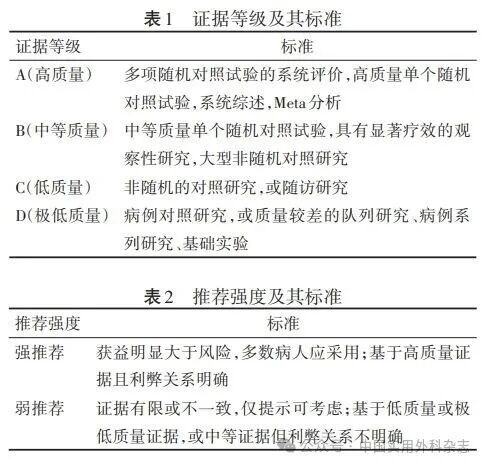

推荐意见与 GRADE 证据分级
| # | 推荐意见 | 证据等级 | 出处 |
|---|---|---|---|
| 1 | TG病人术前需进行营养风险筛查和营养不良评估。营养风险筛查推荐使用NRS-2002,营养评估工具推荐采用PG-SGA或GLIM。(证据等级:A;推荐强度: 强推荐) | 1 | |
| 2 | TG病人营养治疗目标能量需要量可参考25~30 kcal/(kg·d),蛋白质目标量可参考1.0~1.5 g/(kg·d)的标准估算,并个体化调整。(证据等级:B;推荐强度:强推荐) | 1 | |
| 3 | 建议TG病人入院后个体化采用以呼吸训练、运动训练、营养治疗和心理干预为核心的多模式预康复训练以改善术后结局。(证据等级:A;推荐强度: 强推荐) | 1 | |
| 4 | 推荐TG术中选择以Roux-en-Y吻合为核心的消化道重建方式,并采用术中胃镜评估吻合口质量。(证据等级:B;推荐强度: 强推荐) | 1 | |
| 5 | 不推荐TG病人术中常规行空肠营养造口。对于营养风险高的病人,在评估其耐受性和风险后,可行空肠营养造口。(证据等级:B;推荐强度: 弱推荐) | 2 | |
| 6 | 推荐TG术后个体化进行EOF,不推荐常规留置鼻胃管和鼻空肠营养管。(证据等级:A;推荐强度: 强推荐) | 1 | |
| 7 | 对存在吻合口并发症高危因素或预期EOF不耐受者,可在TG术中留置鼻空肠营养管,以便术后实施早期管路EN。(证据等级:A;推荐强度: 强推荐) | 1 | |
| 8 | 推荐TG病人围手术期使用含有免疫营养配方的EN制剂。(证据等级:A;推荐强度: 强推荐) | 1 | |
| 9 | EN联合SPN是TG病人术后营养治疗主要模式;若预计48~72 h EN无法满足机体目标能量及蛋白质需要量60%时,建议尽早给予SPN。(证据等级:A;推荐强度: 强推荐) | 1 | |
| 10 | TG病人不能耐受EN或存在EN禁忌证时,推荐给予TPN。(证据等级:A;推荐强度: 强推荐) | 1 | |
| 11 | 推荐TG病人术后合理补充谷氨酰胺,但对于重症或合并严重肝肾功能障碍的病人,不推荐使用谷氨酰胺。(证据等级:B;推荐强度: 强推荐) | 1 | |
| 12 | TG术后推荐在SPN配方中添加鱼油脂肪乳剂。(证据等级:B;推荐强度: 强推荐) | 1 | |
| 13 | 推荐TG病人术后早期使用短肽型营养制剂,肠道功能稳定后可逐步过渡至整蛋白型。(证据等级:B;推荐强度: 强推荐) | 1 | |
| 14 | TG术后发生食管空肠吻合口漏病人推荐个体化采用外科引流、内镜下夹闭或引流、内镜下覆膜支架或外科手术治疗。(证据等级:B;推荐强度: 强推荐) | 1 | |
| 15 | TG术后发生食管空肠吻合口漏病人推荐通过鼻肠管实施EN,若EN供给不足,推荐联合SPN,甚至TPN。(证据等级:B;推荐强度: 强推荐) | 1 | |
| 16 | 对于TG术后发生高流量乳糜漏病人,推荐禁食联合TPN和生长抑素治疗,低流量乳糜漏可尝试低脂饮食、MCTs、高蛋白和高碳水化合物饮食,或禁食联合TPN治疗。(证据等级:C;推荐强度: 弱推荐) | 2 | |
| 17 | 推荐TG术后病人及早补充维生素B12,并根据个体情况适量补充维生素D、钙、铁、硅及其他微量元素,术后3、6、12个月时监测营养状况和骨密度。(证据等级:B;推荐强度: 强推荐) | 1 | |
| 18 | TG术后推荐进行3~6个月ONS,并可根据病人实际营养状态将ONS延长至≥12个月。(证据等级:C;推荐强度: 强推荐)参考文献(在框内滑动手指即可浏览)[1] Kang MK, Lee HJ. Impact of malnutrition and nutritional support after gastrectomy in patients with gastric cancer[J]. Ann Gastroenterol Surg,2024, 8(4):534-552. DOI: 10.1002/ags3.12788.[2] Akad F, Filip B, Preda C, Zugun-Eloae F, et al. Assessing nutritional status in gastric cancer patients after total versus subtotal gastrectomy: Cross-sectional study[J]. Nutrients,2024, 16(10):1485. DOI: 10.3390/nu16101485. | 1 |
引用 / 出处
中国实用外科杂志. 指南与共识|全胃切除病人全程营养管理中国专家共识(2026版)[J]. 中国实用外科杂志, 2026.